
Does Carrot Weather solve a problem?
When your weather app goes rogue and calls you a meatbag

We review products from the prism of how well they solve the problem they state they're solving for the people they're stating they're solving for.
Today, I'm analysing Carrot Weather, a weather forecasting app best known for its funny and sassy weather updates. Carrot Weather is one of the first indie apps to gain popularity. It won Apple's App of the Year, Apple Design Award, and App Store Editors' Choice. It has also been featured in The New York Times, Good Morning America, CNN, Wired, & more.
What problem is Carrot Weather solving?
Brian Mueller, the developer behind Carrot Weather, identified that weather apps are either overcomplicated or bland, boring, and lacking personality. People use them out of necessity to check temperature or weather forecasts but forget about them the second they don’t require any weather updates.
From a user perspective, I argue that the most important user problem a weather app should solve is providing high-accuracy, real-time weather forecasts. Do users need an entertaining weather app? I don’t think so. Do they want one? After using Carrot Weather for a month, I say yes. Let’s dig into it more!
Who is it for?
There are two main user groups: those who need accurate weather information for everyday tasks and those who want the weather forecasts delivered in a snarky way. I’m unsure if Carrot Weather is suitable enough to plan adventure sports activities where safety depends on highly accurate weather forecasts, like sailing, mountain biking, free-fall climbing, paragliding, etc.
Is Carrot Weather accurate?
It's as accurate as any other weather app since they don't provide their own forecasts but pay for access to weather data from third-party suppliers. Carrot uses Foreca by default, considered one of the most accurate weather services. If you have a subscription, then you can select the source (Apple Weather, AccuWeather, Tomorrow.io, OpenWeather etc.) and experiment to find the best source for your location. I've been using Carrot Weather and Apple Weather simultaneously, and they were both wrong or right, one wrong and the other right, at different times of the day. I didn't find either 100% accurate. What I appreciated more about Carrot Weather was the hourly updates and warnings about weather changes.
What Carrot does differently is how it presents the forecasts, which is highly customizable. From the layout to colors, fonts, type and size, tab icon order, notifications, widgets, app icons, personality, what to show, and whatnot, it provides all the tools to personalize the app. This is a great way to get users involved in designing their own weather app and stir up ownership! I can't recall a similar app that provides this degree of user-interface customization.
Is Carrot Weather entertaining?
Hell yeah, meatbag!
First, you can choose one of five personalities for Carrot AI, from prissy "professional" to profanity-loaded "overkill." Then, if you are into politics, you can select different views, from centrist to anarchist, or go with apolitical to disable any political commentary altogether.
Each personality has a unique tone of voice, and based on the personality you choose, all the content and communication styles are updated. The content is so unique, contextual (depending on weather conditions), and fun that it keeps me returning to the app. I've been in Rome recently, where it rained all day for three days straight, and the only thing that smoothed my frustration was the sarcastic weather forecasts I've been getting from Carrot.
Another thing that stands out is that Mueller regularly updates the app's content to reflect current events—from political headlines to console releases. Reading through Reddit and Twitter comments, I realized some users also use Carrot as a news portal.
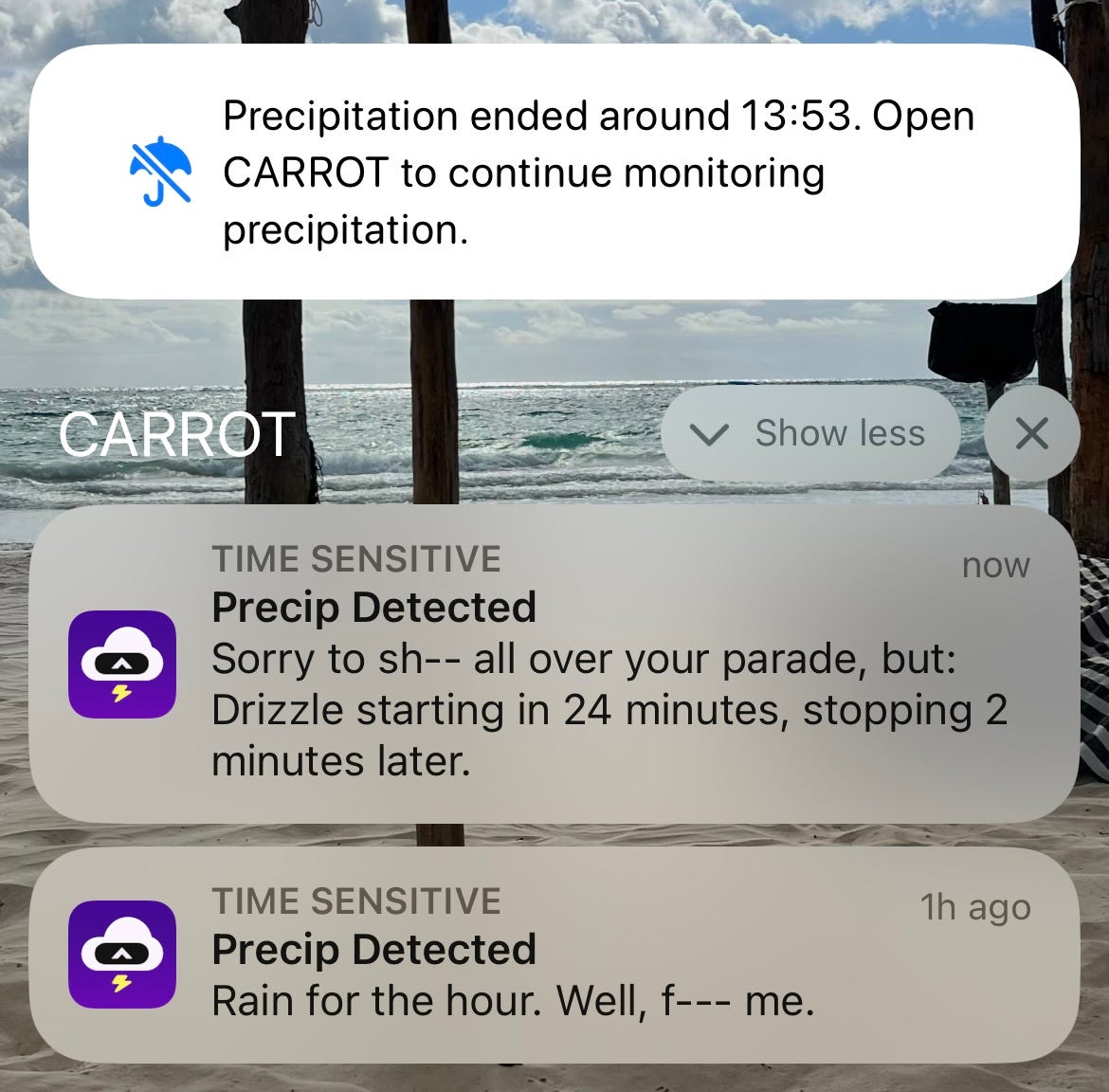
Then, you get missions to track down secret locations (no more than 2 a day, though). There are a bunch of Easter eggs, you can unlock hilariously named achievements and do bonding activities to improve your relationship with Carrot (sending her praise voice messages, picking the energy source of the servers, shaking the app to debug). All these make checking the weather so much fun! Although it seems weird how games could connect to weather forecasts, Mueller found the right way to integrate them beautifully into the app. Be it a weather update or a mission, they all cater to tell the same story around a character called Carrot AI that dramatically hates humans.
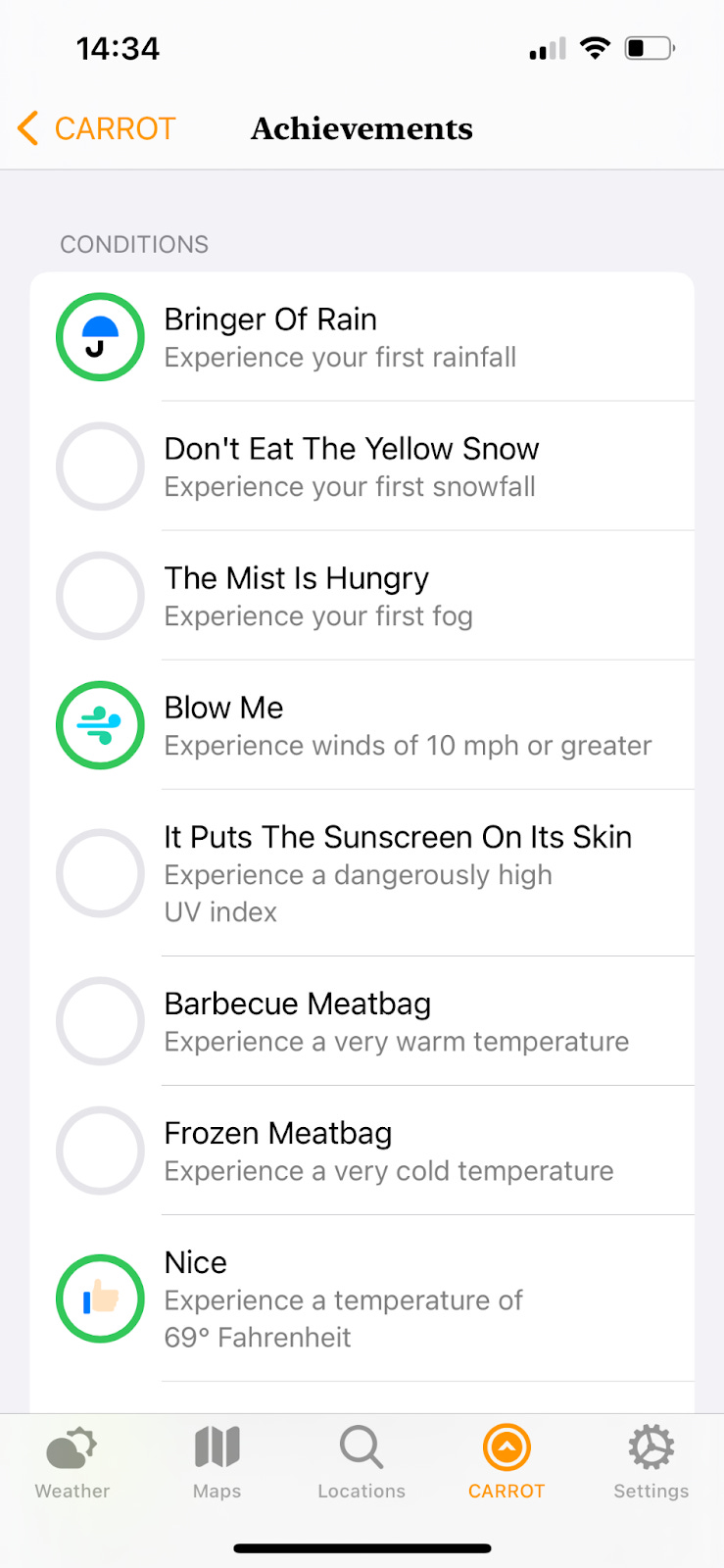
The app employs many gamification tactics to increase engagement and make people come back to the product more often. During my research on Mueller, I stumbled upon a Lifehacker article where he shared the inspiration behind these innovative ideas:
“My first instinct was to add points and badges that I could earn for getting stuff done–typical gamification fare–but the more I thought about it, the more I realised that unlocking some stupid badge wouldn’t make chores more fun for me. When I played games, I wasn’t playing to get a high score. I was playing for the writing, the characters, and the story. Finding out what would happen next was what kept me coming back.
After I made that leap, the idea really started to come together. There’d be a character–this funny/sarcastic/sadistic artificial intelligence named CARROT–at the heart of the app. She’d be almost like a virtual pet, this malevolent supercomputer you have to keep happy by getting stuff done in real life. If you’re successful and efficient, she’d reward you. If you’re lazy, though, she’d get pissed off. And there’d be a central story that revolves around this pet cat that CARROT gives you; the story gets revealed bit by bit as you use the app and changes based on whether she’s happy or angry with you. What I was envisioning was much more game-like than any other “gamification” system I’d ever seen.”
Conclusion
Weather is a crowded category with thousands of apps to choose from, each with its own angles and way of displaying the same data. Many big apps (e.g., Apple's own weather app) are free, making it even harder for indie developers to compete.
Still, I believe Carrot Weather made it. It caters to a basic human need in a creative and distinctive manner. The app not only provides sufficiently accurate weather forecasts but also offers an extensive range of customisation options, ensuring you only see the data that matters to you. The dynamic widget, which appears only under specific conditions, adds to its power. Carrot Weather is a prime example of how to effectively adopt and leverage the latest technologies provided by Apple. I assume Mueller's full-time dedication to developing his Carrot empire is a testament to its financial success.
The design, snarky attitude, and features of Carrot Weather make it a one-of-a-kind app. The small, silly elements that fit the app's character, like hearts falling on the screen when checking the premium membership, never fail to make me smile. Carrot Weather is a fantastic example of effective branding, from understanding the market to defining a unique brand character and story and implementing it in every part of the app.
I chose the "overkill" profane personality, and it makes me wonder why I enjoy (and pay!) someone addressing me as a meatbag and occasionally insulting me. What human behavior and psychology is this connected to? Or does this tell something specific about me? I'll investigate this another time.
Overall, Carrot Weather is an entertaining weather app that I didn't think I needed, but I'm happy to pay for now. After experiencing the regular quirky updates, unique way of presenting weather information, and mini-games, I find it hard to go back to a mundane, boring app like Apple Weather that I used before.